
Next Session: October 5, 2026
How Trauma Informs Love
Join a complimentary 12 lecture series introducing the academically grounded Comprehensive Trauma Informed Coaching Competency Framework (CTICC).
Giving Back to Ignite Global Professional Community
Next Session: October 5, 2026
How Trauma Informs Love
Join a complimentary 12 lecture series introducing the academically grounded Comprehensive Trauma Informed Coaching Competency Framework (CTICC).
Giving Back to Ignite Global Professional Community
Next Session: October 5, 2026
How Trauma Informs Love
Join a complimentary 12 lecture series introducing the academically grounded Comprehensive Trauma Informed Coaching Competency Framework (CTICC).
Giving Back to Ignite Global Professional Community
How does Trauma Inform Love?

Trauma quietly shapes how we relate, attach, protect, and open our hearts. Long before it becomes a story we can name, it lives in the nervous system as memory, expectation, and survival intelligence. It influences how close we allow others to come, how safe intimacy feels, and how we respond to connection, conflict, and care. When trauma remains unseen, love is often filtered through protection. We may love cautiously, conditionally, or from a place of vigilance rather than choice. Patterns such as withdrawal, overgiving, control, or emotional numbing are not failures of love. They are intelligent adaptations formed in response to lived experience.
CTICC invites a deeper understanding of this relationship. Trauma does not oppose love. It informs it. When met with awareness, presence, and ethical attunement, the same adaptations that once protected us can soften, reorganize, and expand our capacity to love with greater safety and authenticity.
By learning to recognize how trauma shapes human behavior, practitioners gain the ability to hold space where love is no longer driven by fear or survival, but guided by choice, regulation, and conscious connection. This is not about fixing or healing in a clinical sense. It is about seeing the whole human clearly, so love can emerge with integrity and depth.
Trauma quietly shapes how we relate, attach, protect, and open our hearts. Long before it becomes a story we can name, it lives in the nervous system as memory, expectation, and survival intelligence. It influences how close we allow others to come, how safe intimacy feels, and how we respond to connection, conflict, and care.
When trauma remains unseen, love is often filtered through protection. We may love cautiously, conditionally, or from a place of vigilance rather than choice. Patterns such as withdrawal, overgiving, control, or emotional numbing are not failures of love. They are intelligent adaptations formed in response to lived experience.
CTICC invites a deeper understanding of this relationship. Trauma does not oppose love. It informs it. When met with awareness, presence, and ethical attunement, the same adaptations that once protected us can soften, reorganize, and expand our capacity to love with greater safety and authenticity.
By learning to recognize how trauma shapes human behavior, practitioners gain the ability to hold space where love is no longer driven by fear or survival, but guided by choice, regulation, and conscious connection.
Trauma quietly shapes how we relate, attach, protect, and open our hearts. Long before it becomes a story we can name, it lives in the nervous system as memory, expectation, and survival intelligence. It influences how close we allow others to come, how safe intimacy feels, and how we respond to connection, conflict, and care. When trauma remains unseen, love is often filtered through protection. We may love cautiously, conditionally, or from a place of vigilance rather than choice. Patterns such as withdrawal, overgiving, control, or emotional numbing are not failures of love. They are intelligent adaptations formed in response to lived experience.
What is the CTICC Framework?
The Comprehensive Trauma Informed Coaching Competency Framework (CTICC) is an academically grounded, evidence-informed framework designed to bring trauma awareness into professional coaching and aligned reflective practices, without crossing into therapy or clinical work.
CTICC translates trauma literacy into clear, teachable competencies that support ethical presence, psychological safety, and scope-aware practice. Rather than offering techniques or interventions, it focuses on how practitioners think, relate, listen, pace, and respond when working with human beings whose lives have been shaped by adversity.
At its core, CTICC:
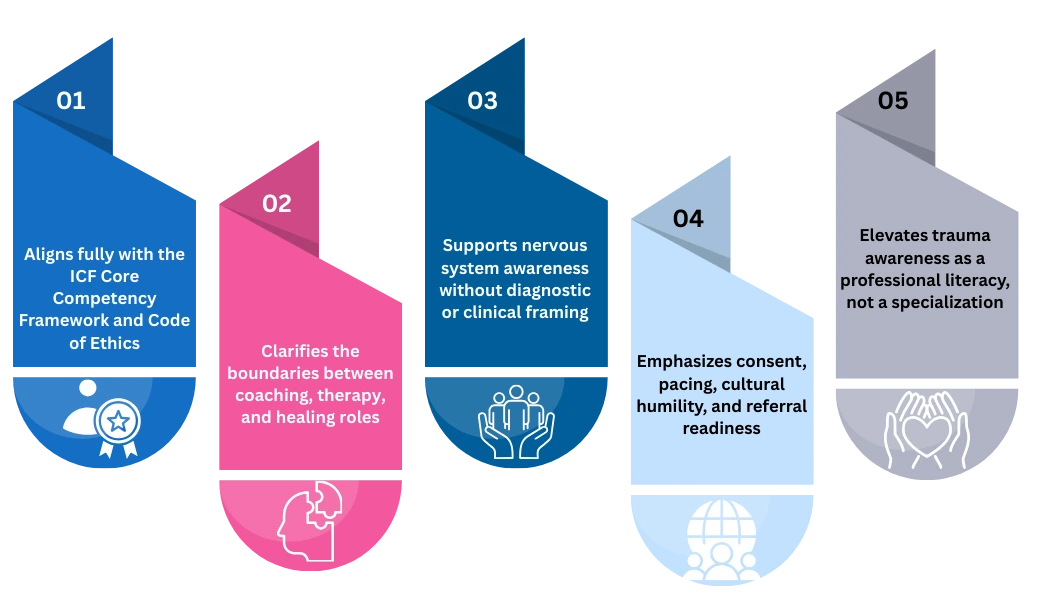
Developed through academic research and professional practice, CTICC serves as a foundational lens for modern reflective work. It helps practitioners recognize how trauma influences goals, relationships, motivation, identity, and growth, so they can respond with greater clarity, care, and ethical confidence.
CTICC is not a model for treatment or healing. It is a competency framework that strengthens how professionals are with people, especially in a world marked by inevitable complexity, adversity, and trauma.
What is this 12-lecture series about?
This complimentary lecture series is a 12-part educational journey designed to introduce, unpack, and integrate the Comprehensive Trauma Informed Coaching Competency Framework (CTICC) in a clear, ethical, and practice grounded way.
Each lecture builds progressively, moving from foundational trauma literacy into applied competency based understanding. The focus is not on techniques or interventions, but on how trauma awareness reshapes presence, perception, relational depth, ethical decision making, and professional maturity across reflective professions.
The series is designed to be accessible, structured, and immediately relevant, whether you work one to one, with groups, teams, or within educational and leadership contexts.
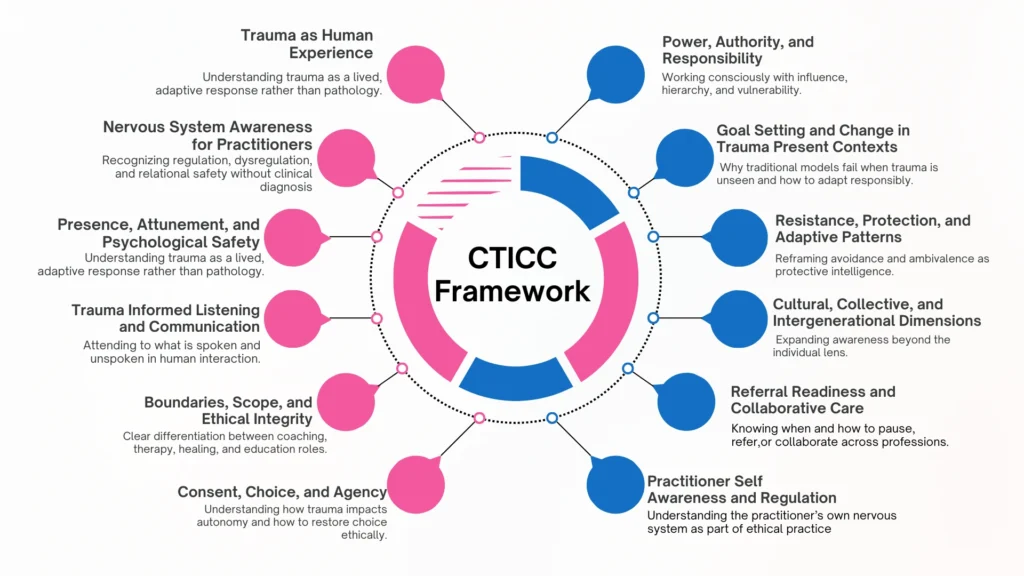
Trauma as Human Experience
Understanding trauma as a lived, adaptive response rather than pathology.
Nervous System Awareness for Practitioners
Recognizing regulation, dysregulation, and relational safety without clinical diagnosis
Presence, Attunement, and Psychological Safety
Understanding trauma as a lived, adaptive response rather than pathology.
Trauma Informed Listening and Communication
Attending to what is spoken and unspoken in human interaction.
Boundaries, Scope, and Ethical Integrity
Clear differentiation between coaching, therapy, healing, and education roles.
Consent, Choice, and Agency
Understanding how trauma impacts autonomy and how to restore choice ethically.
Power, Authority, and Responsibility
Working consciously with influence, hierarchy, and vulnerability.
Goal Setting and Change in Trauma Present Contexts
Why traditional models fail when trauma is unseen and how to adapt responsibly.
Resistance, Protection, and Adaptive Patterns
Reframing avoidance and ambivalence as protective intelligence.
Cultural, Collective, and Intergenerational Dimensions
Expanding awareness beyond the individual lens.
Trauma Informed Listening and Communication
Attending to what is spoken and unspoken in human interaction.
Referral Readiness and Collaborative Care
Knowing when and how to pause, refer,or collaborate across professions.
Practitioner Self Awareness and Regulation
Understanding the practitioner’s own nervous system as part of ethical practice
Trauma as Human Experience
Understanding trauma as a lived, adaptive response rather than pathology.
Nervous System Awareness for Practitioners
Recognizing regulation, dysregulation, and relational safety without clinical diagnosis
Presence, Attunement, and Psychological Safety
Understanding trauma as a lived, adaptive response rather than pathology.
Trauma Informed Listening and Communication
Attending to what is spoken and unspoken in human interaction.
Boundaries, Scope, and Ethical Integrity
Clear differentiation between coaching, therapy, healing, and education roles.
Consent, Choice, and Agency
Understanding how trauma impacts autonomy and how to restore choice ethically.
Power, Authority, and Responsibility
Working consciously with influence, hierarchy, and vulnerability.
Goal Setting and Change in Trauma Present Contexts
Why traditional models fail when trauma is unseen and how to adapt responsibly.
Resistance, Protection, and Adaptive Patterns
Reframing avoidance and ambivalence as protective intelligence.
Cultural, Collective, and Intergenerational Dimensions
Expanding awareness beyond the individual lens.
Referral Readiness and Collaborative Care
Knowing when and how to pause, refer,or collaborate across professions.
Practitioner Self Awareness and Regulation
Understanding the practitioner’s own nervous system as part of ethical practice
Important Note
This overview is provided to offer clarity and orientation only. The full CTICC framework, including detailed competencies, definitions and applied criteria, is reserved for academic publication and advanced training pathways.
What is the delivery format of the lecture series?
- 12 live lectures delivered across 2026
- One session per month to allow time for reflection and integration
- 90 minutes per session, designed for depth without overload
- Conducted live via Zoom, accessible globally
This overview is provided to offer clarity and orientation only. The full CTICC framework, including detailed competencies, definitions, and applied criteria, is reserved for academic publication and advanced training pathways.
What is the delivery format of the lecture series?
- 12 live lectures delivered across 2026
- One session per month to allow time for reflection and integration
- 90 minutes per session, designed for depth without overload
- Conducted live via Zoom, accessible globally
Who is this lecture series for?
This lecture series is designed for professionals who work with human growth, development, and transformation, and who recognize the importance of safety, ethics, and depth in their practice.
It is especially relevant for:

Professional coaches across all credential levels and specialties
Psychotherapists and counsellors seeking trauma informed awareness that respects scope boundaries
Healers and facilitators working in reflective, somatic, or consciousness based contexts
Educators and trainers supporting learning, development, and wellbeing
Leaders and organizational practitioners committed to psychologically safe and human centered leadership
This series is for those who:
- Sense that insight and goal setting alone are not always enough
- Want to understand how trauma shapes behavior, motivation, and relationships
- Care deeply about ethical practice, consent, and professional boundaries
- Seek a shared language for trauma informed awareness without becoming clinical
- Are ready to expand their lens while staying true to their professional role
It is especially relevant for:
Professional coaches across all credential levels and specialties
Psychotherapists and counsellors seeking trauma informed awareness that respects scope boundaries
Healers and facilitators working in reflective, somatic, or consciousness based contexts
Educators and trainers supporting learning, development, and wellbeing
Leaders and organizational practitioners committed to psychologically safe and human centered leadership
This series is for those who:
- Sense that insight and goal setting alone are not always enough
- Want to understand how trauma shapes behavior, motivation, and relationships
- Care deeply about ethical practice, consent, and professional boundaries
- Seek a shared language for trauma informed awareness without becoming clinical
- Are ready to expand their lens while staying true to their professional role
This series is for those who:
- Sense that insight and goal setting alone are not always enough
- Want to understand how trauma shapes behavior, motivation, and relationships
- Care deeply about ethical practice, consent, and professional boundaries
- Seek a shared language for trauma informed awareness without becoming clinical
- Are ready to expand their lens while staying true to their professional role
Important Scope and Ethics Clarification

This lecture series is an introductory educational offering created to raise awareness of the CTICC Framework as part of introducing it to the world. It supports practitioners in becoming more aware of how trauma can influence clients, relationships, and developmental processes across professional contexts.
Participation in this series does not qualify or authorize individuals to describe themselves as trauma informed practitioners, nor does it provide training in trauma intervention, treatment, or therapeutic application.
Ethical integration of trauma informed practice requires further structured training, supervised practice, and ongoing professional development, aligned with one’s original scope of practice, professional standards, and regulatory requirements. This series exists to cultivate awareness, literacy, and ethical orientation, so practitioners can recognize trauma dynamics responsibly, know when to slow down, and understand when referral, collaboration, or supervision is required. If you are working with people in a world marked by inevitable complexity, adversity, and trauma, this series is designed to support you in doing so with greater presence, clarity, and care
This lecture series is an introductory educational offering created to raise awareness of the CTICC Framework as part of introducing it to the world. It supports practitioners in becoming more aware of how trauma can influence clients, relationships, and developmental processes across professional contexts.
Participation in this series does not qualify or authorize individuals to describe themselves as trauma informed practitioners, nor does it provide training in trauma intervention, treatment, or therapeutic application.
Ethical integration of trauma informed practice requires further structured training, supervised practice, and ongoing professional development, aligned with one’s original scope of practice, professional standards, and regulatory requirements. This series exists to cultivate awareness, literacy, and ethical orientation, so practitioners can recognize trauma dynamics responsibly, know when to slow down, and understand when referral, collaboration, or supervision is required. If you are working with people in a world marked by inevitable complexity, adversity, and trauma, this series is designed to support you in doing so with greater presence, clarity, and care
Your Lead Facilitator
Fernando Hettiyadura
Eclectic Psychotherapist, ICF MCC

Fernando Hettiyadura is a pioneering specialist in professional coaching, psychotherapy, and spiritual practices encompassing Psychedelic Integration as the center of his interventions. As an Eclectic Psychotherapist, a Master Certified Coach (MCC) designated by the International Coaching Federation (ICF), and a serial entrepreneur, he leads a global movement toward conscious living and healing through his visionary organizations—Ignite Global, Evolving Temple, and Awaken Mind Guide.
With over 18 years of experience and 4,000+ hours of documented therapeutic practice, Fernando blends Eastern and Western approaches to support clients in areas of trauma healing, relationships, leadership, spirituality, personal and professional growth. His academic background includes an MSc in Counseling Psychology, postgraduate certification in Ayurveda Psychology, certification in Clinical Regression, and psychiatry coursework from Harvard University. He is currently pursuing a PhD in Psychology, researching the use of Psychedelic-Assisted Therapy in treating childhood trauma.
As ICF Program Director at Ignite Global 360, Fernando designs and leads cutting-edge, accredited training programs for coaches and clinicians worldwide. He also developed the world’s first ICF-accredited Trauma-Informed Psychedelic Integration Practitioner Qualification, setting a new standard in the field. His work continues to empower individuals and professionals to access deeper healing and human potential.
Fernando Hettiyadura is a pioneer in the fields of professional coaching, psychotherapeutic, and spiritual practices. He is an Integrative Psychotherapist in supervision and a Master Certified Coach (MCC) designated by the International Coaching Federation (ICF). As the founder of Ignite Global, Evolving Temple, and Awaken Mind Guide, Fernando has created a dynamic ecosystem of organizations committed to elevating human potential through the expansion of consciousness.
Fernando’s academic background comprises an MSc in Counseling Psychology from Girne American University, further enriched by medical psychiatry coursework (2024) from Harvard University, a postgraduate certification in Ayurveda Psychology, and certification in Clinical Regression, encompassing Clinical Hypnotherapy, Past Life Regression, and Transpersonal Therapy. At present, Fernando is a PhD candidate in Psychology; his research focuses on the integration of Psychedelic-Assisted Therapy in treating childhood trauma. He also pursues an Executive Diploma in Clinical Psychology, underscoring his dedication to professional advancement.
Fernando’s expertise as a transformational practitioner merges Eastern and Western modalities, seamlessly blending clinical and metaphysical aspects. As an empathetic catalyst for growth, Fernando believes that everyone possesses infinite innate wisdom capable of fostering a fulfilling personal and professional life. Fernando’s offerings span areas of trauma, relationships, leadership, and spirituality. His approach combines diverse psychotherapeutic techniques with psychosomatic and spiritual practices, alongside Sacred Psychedelic Integration, tailored to meet the unique needs of each client.
With 18 years of experience and over 4,000 hours of documented coaching and therapy, he serves a diverse global clientele, including students, professionals, leaders, and organizations driven by transformation.
In his role as the ICF Program Director at Ignite Global 360, Fernando leads comprehensive ICF-Accredited Specialized Professional Development Programs, guiding coaches and clinicians from foundational skills to advanced mastery. Fernando created world’s pioneering Trauma-Informed Psychedelic Integration Advanced Practitioner Qualification with the prestigious accreditation by the ICF, adding a unique dimension to the spectrum of professional coaching.
Outside of his professional endeavors, Fernando finds joy in salsa dancing, solace in nature, and profound peace in Vipassana meditation.
With 18 years of experience and over 4,000 hours of documented coaching and therapy, he serves a diverse global clientele, including students, professionals, leaders, and organizations driven by transformation.
In his role as the ICF Program Director at Ignite Global 360, Fernando leads comprehensive ICF-Accredited Specialized Professional Development Programs, guiding coaches and clinicians from foundational skills to advanced mastery. Fernando created world’s pioneering Trauma-Informed Psychedelic Integration Advanced Practitioner Qualification with the prestigious accreditation by the ICF, adding a unique dimension to the spectrum of professional coaching.
Outside of his professional endeavors, Fernando finds joy in salsa dancing, solace in nature, and profound peace in Vipassana meditation.
Does this series include CPD or CCE certification?
Yes. Participants who meet the attendance requirements will be eligible to receive complimentary CPD and CCE certificates, aligned with professional continuing education standards.
To qualify:
Participants must attend at least 80% of the lectures live
Attendance must be live, as the series emphasizes presence, reflection, and real time engagement
Certificates are issued in alignment with continuing education frameworks recognized by professional bodies such as the International Coaching Federation and the International Association of Therapists
If you are unable to attend a session live due to time zone or scheduling constraints, recorded sessions will be made available via Awaken Mind Guide.
Please note:
- CPD and CCE credits are available only for live attendance
- Recorded sessions are provided for learning and awareness purposes
- Viewing recordings does not qualify for CPD or CCE certification
This approach maintains the integrity of the learning experience while ensuring access for participants across different regions.
Schedule of the Lecture Series
Our interactive live sessions are designed to accommodate your schedule, with classes scheduled conveniently from 9.30pm to 11.00 pm Indochina Time (Bangkok Time).
| 9 February | 9 March |
| 13 April | 11 May |
| 8 June | 13 July |
| 10 August | 14 September |
| 12 October | 9 November |
| 7 December | 11 January 2027 |
How can I apply and receive an invitation?
Application Review (Selection process)
Not everyone who applies will be accepted. Applications are reviewed carefully.
Step 2Invitation Sent to Selected Participants
Invitations are sent Only to practitioners who show strong interest, responsibility, and commitment.
Step 3Attend and Actively Participate
Invited participants are expected to attend live, participate actively, and respect the trauma-aware learning environment.
Step 4What to expect from the application process
- Applicants are invited to share their intention for joining the series
- Applications are reviewed on a rolling basis
- Selected participants will receive a formal invitation and confirmation email
- Seek a shared language for trauma informed awareness without becoming clinical
- Spaces are limited to support learning quality, interaction, and safety
Access to Recordings
If you are unable to attend a session live due to time zone or scheduling constraints, recorded sessions will be made available via Awaken Mind Guide for learning and awareness purposes.
Please note that CPD and CCE credits are awarded only for live attendance.
HOW TRAUMA INFORMS LOVE
APPLY TO JOIN THE CTICC LECTURE SERIES:
This complimentary offering is our way of giving back to the global community of
reflective professionals who are pioneering ethical, human centered transformation.
reflective professionals who are pioneering ethical, human centered transformation.
Application Form
Internal Search Keywords:
trauma-informed, coaching, trauma coaching