

Table of Contents
ToggleMany adults move through life believing that secure relationships are something they either had or missed. If you didn’t grow up feeling emotionally safe, consistently supported, or deeply understood, it can seem as though secure attachment is out of reach.
Attachment science tells us otherwise.
Earned secure attachment is a well-researched phenomenon showing that people who did not experience secure attachment in childhood can develop it later in life. This does not happen overnight, and it does not happen through insight alone. Earned security is a developmental process, one that unfolds through awareness, nervous system regulation, relational repair, and embodied emotional safety.
This article explores the stages of earned secure attachment, offering a realistic and compassionate map for understanding how attachment healing actually happens.
What Is Earned Secure Attachment?
Earned secure attachment refers to a state of emotional security developed in adulthood, despite early attachment disruptions such as emotional neglect, inconsistency, trauma, or relational instability.
Research in attachment theory, particularly the work of Mary Main, shows that individuals can develop secure attachment through:
- Reflective self-awareness
- Coherent understanding of their relational history
- Emotionally corrective relationships
- Improved emotional regulation
Importantly, earned security is not the absence of wounds. It is the ability to relate to oneself and others with clarity, flexibility, and emotional safety, even in the face of challenges.
Earned Secure Attachment Is a Process, Not a Personality Trait
One of the most common misunderstandings is that attachment styles are fixed labels. In reality, attachment is adaptive and dynamic.
Earned secure attachment develops gradually and often in a non-linear manner. You may move forward, revisit earlier stages, or notice old patterns resurface during stress or life transitions. This does not mean you are failing; it means your nervous system is responding to new demands. What matters is not perfection, but capacity for awareness, regulation, and repair.

The Stages of Earned Secure Attachment
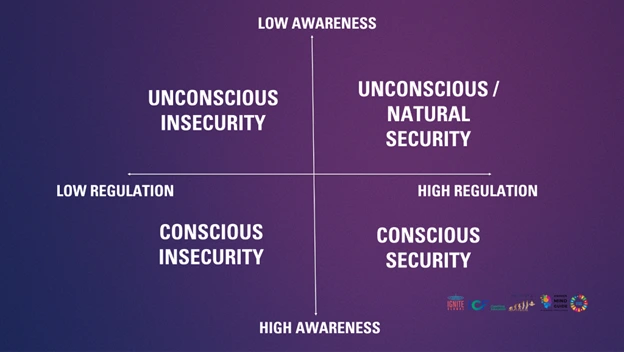
Earned secure attachment does not emerge suddenly or through insight alone. It develops gradually through distinct developmental stages, shaped by increasing awareness, emotional regulation, and relational experience. These stages can be understood through a four-quadrant attachment model, which reflects two essential dimensions of attachment development:
- Awareness of one’s attachment patterns
- Capacity for emotional regulation and relational security
Together, these dimensions form four attachment quadrants that describe how people move from unconscious insecurity toward integrated, embodied security.
This framework helps normalize the attachment healing journey. It explains why progress often feels gradual, uneven, and non-linear, and why “knowing better” does not immediately translate into feeling or relating differently. Each stage represents a meaningful phase of growth rather than a flaw or failure.
Stage 1: Unconscious Insecurity
(Insecure attachment without awareness)
At this stage, attachment insecurity is active but largely invisible to the individual.
People in unconscious insecurity often experience intense relational distress, such as anxiety, emotional reactivity, withdrawal, or shutdown, without understanding its origins. Attachment patterns are expressed automatically, driven by early survival adaptations rather than conscious choice.
Relationships may feel confusing, overwhelming, or disappointing, and similar dynamics tend to repeat across different connections. Distress is often attributed to external factors, “the wrong partner,” “bad luck,” or “other people’s behavior, rather than internal attachment patterns.
Common experiences include:
- Feeling “too much,” needy, or emotionally intense without understanding why
- Pulling away from closeness while simultaneously longing for connection
- Repeating familiar relational dynamics despite wanting something different
- Oscillating between self-blame and blaming others for relational pain
At this stage, attachment is not yet something a person reflects on; it is something they live out unconsciously.
Stage 2: Conscious Insecurity
(Insecure attachment with awareness)
This stage marks a crucial developmental shift: awareness emerges.
Individuals begin to recognize their attachment style, anxious, avoidant, or fearful-avoidant, and understand how early relational experiences shaped their current patterns. They start naming triggers, emotional responses, and relational fears with greater clarity.
While attachment insecurity is still active, it is now observable rather than invisible. This awareness can be both empowering and frustrating. People often describe this stage as “waking up” to their patterns but feeling unsure how to change them.
Common experiences include:
- Identifying attachment triggers and emotional responses
- Understanding the childhood roots of insecurity
- Feeling frustrated by “knowing better but still reacting.”
- Oscillating between insight, hope, and emotional overwhelm
This stage can feel uncomfortable because awareness develops faster than regulation. Old patterns are no longer unconscious, but new skills have not yet been fully integrated.
Stage 3: Conscious Security
(Earned secure attachment in development)
This stage represents the core of earned secure attachment.
Here, individuals actively and intentionally practice secure attachment behaviors, even when old insecurities are triggered. Emotional regulation, reflection, and repair become conscious skills rather than automatic reactions. While insecurity may still arise, it no longer dictates behavior in the same way.
People in this stage begin responding rather than reacting. They make different relational choices, not because insecurity has disappeared, but because they have developed a greater capacity to work with it.
Common experiences include:
- Pausing before reacting emotionally
- Communicating needs and boundaries more clearly
- Setting limits with reduced guilt or fear
- Choosing relationships more consciously and discerningly
- Recovering from triggers more quickly and with greater self-compassion
Security at this stage is deliberate and practiced. It requires awareness, effort, and reflection, but it is deeply transformative and stabilizing.
Stage 4: Unconscious/Natural Security
(Integrated secure attachment)
At this stage, secure attachment becomes embodied and largely automatic.
Emotional regulation, trust, boundaries, and intimacy feel natural rather than effortful. Secure behaviors no longer require constant conscious management; they emerge organically from an integrated sense of self.
Old attachment wounds may still exist as part of personal history, but they no longer dominate relational life or self-perception. Individuals trust themselves in relationships and feel resilient in the face of conflict or uncertainty.
Common experiences include:
- Comfort with both intimacy and autonomy
- A stable and positive sense of self-worth
- Emotional resilience during relational challenges
- Trust in oneself and others
- Reduced preoccupation with relational outcomes or approval
This stage closely resembles innate secure attachment, with one key difference, which is that it was consciously developed through reflection, regulation, and relational repair, rather than formed automatically in early childhood.

Key Steps of the Journey Toward Earned Secure Attachment
Movement through the attachment quadrants does not happen through a single breakthrough or linear progression. Instead, Earned Secure Attachment develops through several core developmental processes that unfold over time. These processes overlap, reinforce one another, and deepen through lived experience.
Each aspect contributes to the gradual shift from unconscious insecurity toward integrated, embodied security.
1. Awareness & Understanding
Recognizing Attachment Patterns
The journey toward earned secure attachment begins with insight, the ability to recognize and make sense of one’s attachment patterns.
This stage involves developing an understanding of:
- One’s attachment style (anxious, avoidant, or fearful)
- Emotional triggers and relational sensitivities
- How early caregiving and relational experiences shaped current behaviors and expectations
Rather than labeling oneself as “broken” or “too much,” awareness provides context. It replaces self-judgment with understanding and allows individuals to observe their patterns instead of being unconsciously driven by them.
Awareness transforms confusion into clarity and creates choice where there was once an automatic reaction.
2. Self-Regulation & Healing
Stabilizing the Nervous System
Attachment insecurity is stored not only in thoughts, but in the body and nervous system. For this reason, insight alone is not enough to create lasting change.
Healing at this stage involves learning how to:
- Soothe emotional overwhelm and physiological arousal
- Stay present during discomfort without shutting down or escalating
- Practice mindfulness, grounding, and body-based regulation
- Gently challenge deeply held negative self-beliefs rooted in early experiences
As emotional regulation improves, attachment triggers feel less urgent and less consuming. Individuals begin to experience a growing sense of internal safety, reducing the need to seek constant reassurance or distance.
Self-regulation creates the emotional foundation upon which secure attachment can be built.
3. Building Secure Relationships (Co-Regulation)
Learning Safety through Connection
Earned secure attachment does not develop in isolation. While self-regulation is essential, co-regulation, the experience of being emotionally supported by another, is equally vital.
Secure partners, friends, mentors, or therapists provide:
- Emotional attunement (feeling seen, heard, and understood)
- Consistency and reliability over time
- Comfort and validation during distress
- Repair and reassurance after relational ruptures
These relationships offer felt safety, allowing the nervous system to learn, through experience, that connection does not automatically lead to abandonment, engulfment, or harm.
Repeated experiences of relational safety are what gradually reshape internal working models.
4. Developing Secure Behaviors
Practicing Security in Real Life
As awareness and regulation increase, behavior begins to change. Secure attachment is not only felt internally, but it is also expressed relationally.
This stage involves practicing secure behaviors such as:
- Open, honest, and respectful communication
- Setting healthy boundaries without excessive guilt or fear
- Trusting others appropriately rather than through hypervigilance or avoidance
- Navigating conflict without collapsing, withdrawing, or escalating
- Allowing intimacy while maintaining a sense of self
These behaviors may initially feel unfamiliar or uncomfortable, especially for those whose early relationships required survival-based strategies. Over time, however, secure behaviors become more natural and self-reinforcing.
Security becomes something you practice, not because you are forcing change, but because your internal capacity has grown.
5. Integration
Embodied Earned Security
With time and repetition, these experiences integrate into a stable and coherent sense of self and relationships. Earned secure attachment becomes less effortful and more embodied.
At this stage, individuals often experience:
- A positive and consistent sense of self-worth
- Comfort with both closeness and independence
- Emotional flexibility and resilience
- Greater stability during relational stress or uncertainty
Security no longer requires constant monitoring or conscious effort. While challenges and triggers may still arise, they no longer dominate emotional or relational life.
At this point, earned secure attachment begins to resemble innate secure attachment, even though it was consciously developed through awareness, regulation, and relational repair.
What Earned Secure Attachment Is Not
To understand earned secure attachment accurately, it is just as important to clarify what it is not. Security is often misunderstood as emotional distance, self-sufficiency, or the absence of vulnerability. In reality, secure attachment reflects greater emotional capacity, not less.
Earned secure attachment is not:
- Emotional detachment or numbness
Secure individuals are not shut down or disconnected from their feelings. They experience emotions fully but can stay present with them without becoming overwhelmed or avoidant. - Hyper-independence or self-reliance at all costs
Security does not mean needing no one. It allows for healthy interdependence, being able to rely on others while also trusting oneself. - The absence of needs or desires for connection
Secure attachment includes having needs, expressing them openly, and receiving support without shame or fear of rejection. - Never feeling anxious, triggered, or distressed
Triggers are part of being human. What changes with security is not the absence of emotional activation, but the ability to regulate, reflect, and repair when it arises.
Earned secure attachment allows for vulnerability, emotional depth, and relational repair. It is not about avoiding discomfort; it is about meeting it with awareness, compassion, and resilience.

Signs You Are Moving Toward Earned Secure Attachment
Progress toward earned secure attachment often does not announce itself through dramatic change. More commonly, it shows up in quiet, stabilizing shifts in how you experience yourself and your relationships. These changes may feel subtle at first, but over time, they significantly alter your emotional and relational landscape.
You may be developing earned secure attachment if you notice:
- Less preoccupation with others’ responses
You find yourself spending less time analyzing messages, tone, or availability. While connection still matters, your sense of safety no longer depends on constant reassurance or external validation. - Increased self-trust and emotional clarity
You feel more confident in your perceptions, decisions, and emotional responses. Instead of second-guessing yourself, you can hold your experiences with greater certainty and compassion. - An ability to pause before reacting
Emotional triggers may still arise, but you are more able to slow down, reflect, and choose how to respond rather than reacting automatically from fear or urgency. - Comfort with both closeness and space
Intimacy feels less consuming, and distance feels less threatening. You can enjoy connection without losing yourself and tolerate separation without spiraling or withdrawing emotionally. - Stronger boundaries without withdrawal or guilt
You can say no, express limits, or advocate for your needs without excessive anxiety, people-pleasing, or emotional shutdown.
These shifts are often gradual and internal, yet they create a deep sense of stability, groundedness, and relational ease. They are strong indicators that earned secure attachment is taking root.
Why Earned Secure Attachment Is a Lifelong Practice
Progress toward earned secure attachment often does not announce itself through dramatic change. More commonly, it shows up in quiet, stabilizing shifts in how you experience yourself and your relationships. These changes may feel subtle at first, but over time, they significantly alter your emotional and relational landscape.
You may be developing earned secure attachment if you notice:
- Less preoccupation with others’ responses
You find yourself spending less time analyzing messages, tone, or availability. While connection still matters, your sense of safety no longer depends on constant reassurance or external validation. - Increased self-trust and emotional clarity
You feel more confident in your perceptions, decisions, and emotional responses. Instead of second-guessing yourself, you can hold your experiences with greater certainty and compassion. - An ability to pause before reacting
Emotional triggers may still arise, but you are more able to slow down, reflect, and choose how to respond rather than reacting automatically from fear or urgency. - Comfort with both closeness and space
Intimacy feels less consuming, and distance feels less threatening. You can enjoy connection without losing yourself and tolerate separation without spiraling or withdrawing emotionally. - Stronger boundaries without withdrawal or guilt
You can say no, express limits, or advocate for your needs without excessive anxiety, people-pleasing, or emotional shutdown.
These shifts are often gradual and internal, yet they create a deep sense of stability, groundedness, and relational ease. They are strong indicators that earned secure attachment is taking root.

Closing Reflection
Earned secure attachment is not about becoming someone else or fixing what is “wrong.” It is about coming home to yourself, with clarity, self-compassion, and the capacity for safe, meaningful connection.
Security is not something you chase, prove, or achieve through perfection. It is something you build through awareness, regulation, and relationship.
And over time, those moments become a way of being…
Thank you for reading and for your heartfelt support and interest.
May love lead you gently back home to yourself.
With grace and gratitude,
Lux Hettiyadura
Directress, Child/Adolescent Development & Parenting Coach Education – Ignite Global
If This Resonated With You…
🌱Join my free monthly Attachment Healing Circle, a safe, supportive space to heal your attachment system through secure, nurturing connections. Join here.
🎥 Keep Learning – Watch related videos on my YouTube channel where I break down attachment science into everyday language and share tools you can use right away. Watch here.
📚Read More- If you’d like to explore this topic further, I invite you to read my earlier article, Why You Keep Choosing Unavailable Partners: The Truth About Anxious Attachment. Read here.
💌 Join the Conversation – Subscribe to my newsletter, Strings Attached, to receive regular insights, stories, and resources on attachment, relationships, and healing.
🤝 Share the Love – If this article touched you, share it with someone who may need these words today. Sometimes, the smallest act of passing on knowledge can create the biggest ripple in someone’s healing journey.
🌿 Stay Connected – Healing is not meant to be done alone. By staying connected, you’re creating a community of awareness, compassion, and growth.
References
This article draws on established attachment theory, neuroscience, trauma research, and developmental psychology. The four-quadrant model presented is a conceptual framework intended for educational and reflective purposes rather than clinical diagnosis.
Bowlby, J. (1969) Attachment and Loss: Volume I: Attachment. New York: Basic Books.
Bowlby, J. (1988) A Secure Base: Parent–Child Attachment and Healthy Human Development. London: Routledge.
Ainsworth, M.D.S., Blehar, M.C., Waters, E. and Wall, S. (1978) Patterns of Attachment: A Psychological Study of the Strange Situation. Hillsdale, NJ: Lawrence Erlbaum Associates.
Main, M., Kaplan, N. and Cassidy, J. (1985) ‘Security in infancy, childhood, and adulthood: A move to the level of representation’, Monographs of the Society for Research in Child Development, 50(1–2), pp. 66–104.
Main, M. and Goldwyn, R. (1998) Adult Attachment Scoring and Classification System. Unpublished manuscript, University of California at Berkeley.
Fonagy, P., Gergely, G., Jurist, E.L. and Target, M. (2002) Affect Regulation, Mentalization, and the Development of the Self. New York: Other Press.
Siegel, D.J. (1999) The Developing Mind: How Relationships and the Brain Interact to Shape Who We Are. New York: Guilford Press.
Siegel, D.J. (2012) The Developing Mind: How Relationships and the Brain Interact to Shape Who We Are (2nd edn). New York: Guilford Press.
Porges, S.W. (2011) The Polyvagal Theory: Neurophysiological Foundations of Emotions, Attachment, Communication, and Self-Regulation. New York: W.W. Norton & Company.
van der Kolk, B.A. (2014) The Body Keeps the Score: Brain, Mind, and Body in the Healing of Trauma. New York: Viking.
Schore, A.N. (2001) ‘Effects of a secure attachment relationship on right brain development, affect regulation, and infant mental health’, Infant Mental Health Journal, 22(1–2), pp. 7–66.
Cassidy, J. and Shaver, P.R. (eds.) (2016) Handbook of Attachment: Theory, Research, and Clinical Applications (3rd edn). New York: Guilford Press.
Mikulincer, M. and Shaver, P.R. (2016) Attachment in Adulthood: Structure, Dynamics, and Change (2nd edn). New York: Guilford Press.