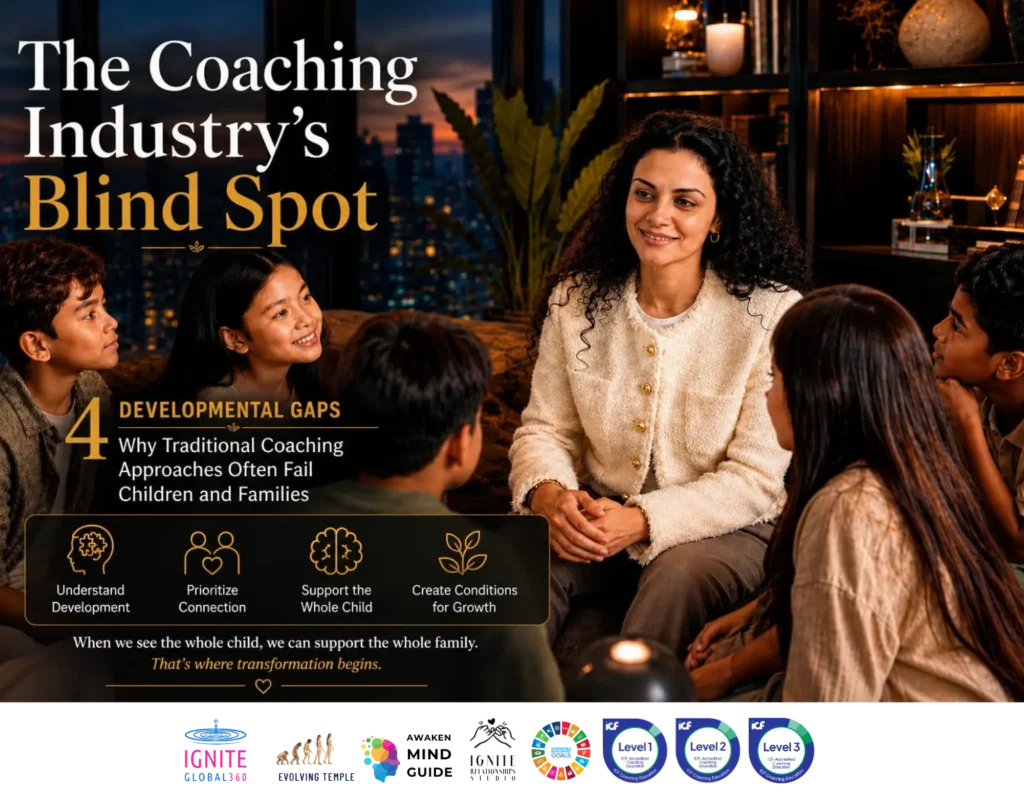
The Coaching Industry’s Blind Spot: 4 Developmental Gaps Why Traditional Coaching Approaches Often Fail Children and Families

If you have ever worked with children, adolescents, or families as a coach, educator, or developmental professional, you have likely encountered moments when traditional coaching approaches seem to reach their limits.

You ask reflective questions, but the child struggles to engage meaningfully.

You work with parents who genuinely want to change, yet the same emotional and behavioural patterns continue to repeat at home.

The parents’ childhood experiences and trauma show up, but you don’t know how to take the conversation forward without crossing professional boundaries. 

You introduce tools, strategies, and interventions that appear effective temporarily, only to see the same challenges resurface weeks later.

Certain sensitive topics come up, but you don’t know how to effectively safeguard the child while maintaining professional boundaries. 

Sounds familiar? You are not alone.

These experiences are far more common than many professionals openly discuss.

And often, they lead to an important but uncomfortable question:

What if the challenge is not the child, the parent, or even the professional’s coaching ability, but the model itself?

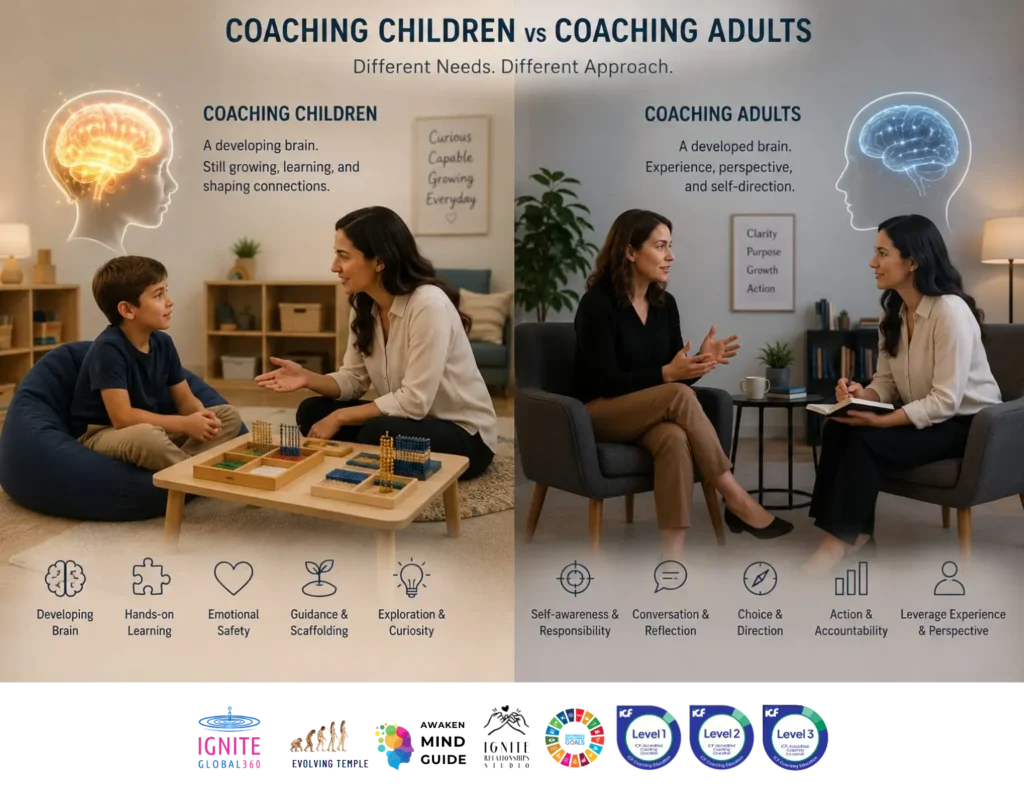
One of the largest blind spots within the coaching industry today is that most mainstream coaching models were originally developed for adults with relatively mature cognitive capacities, developed self-awareness, reflective ability, emotional language, and a more stable sense of identity.

Children do not function from the same developmental position.

Yet many professionals unknowingly apply adult-oriented and generic coaching frameworks to minors whose brains, nervous systems, emotional regulation capacities, and sense of self are still developing.

This creates a significant developmental mismatch.

1. Children Are Not Smaller Adults

This may sound like an obvious concept, yet many coaching and educational approaches still operate as though children simply require simplified versions of adult interventions.

Traditional coaching models largely assume that the client has the ability to:

  • Reflect on their internal experiences
  • Verbalize emotions clearly
  • Regulate impulses consistently
  • Think abstractly and future-oriented
  • Sustain self-awareness
  • Independently implement behavioural change

These assumptions generally fit adult clients reasonably well. But children and adolescents are still actively developing these capacities.

A child’s brain is still undergoing rapid structural and functional development, particularly in areas responsible for impulse control, emotional regulation, executive functioning, social reasoning, and long-term decision making. 

Emotional regulation is also not fully internalized in early development; it is first learned relationally through co-regulation with caregivers and emotionally safe environments.

This means that many of the capacities traditional coaching models rely upon are still emerging during childhood and adolescence.

For example, when a child becomes emotionally reactive, avoidant, oppositional, or withdrawn, adults often interpret the behaviour through a behavioural or motivational lens:

  • “They are misbehaving.”
  • “They are attention-seeking.”
  • “They are being manipulative.”
  • “They are unmotivated.”

However, developmental and nervous system-informed perspectives often reveal something far more complex underneath the surface.

A child who appears oppositional may actually be overwhelmed.
A teenager who disengages may be protecting themselves from shame or emotional exposure.
A child who cannot focus may be struggling with nervous system dysregulation rather than a lack of effort or discipline.

Without developmental understanding, professionals can unintentionally misinterpret adaptive stress responses as intentional behavioural problems.

2. Behaviour Is Often Treated as the Problem Instead of Communication

One of the most common frustrations professionals experience when working with children and families is the recurring nature of behavioural struggles.

Have you encountered your client getting stuck with:

The same emotional outbursts continuesly?
The same family conflicts repeat?
The same patterns persist despite interventions, rewards, consequences, coaching conversations, or behavioural strategies?

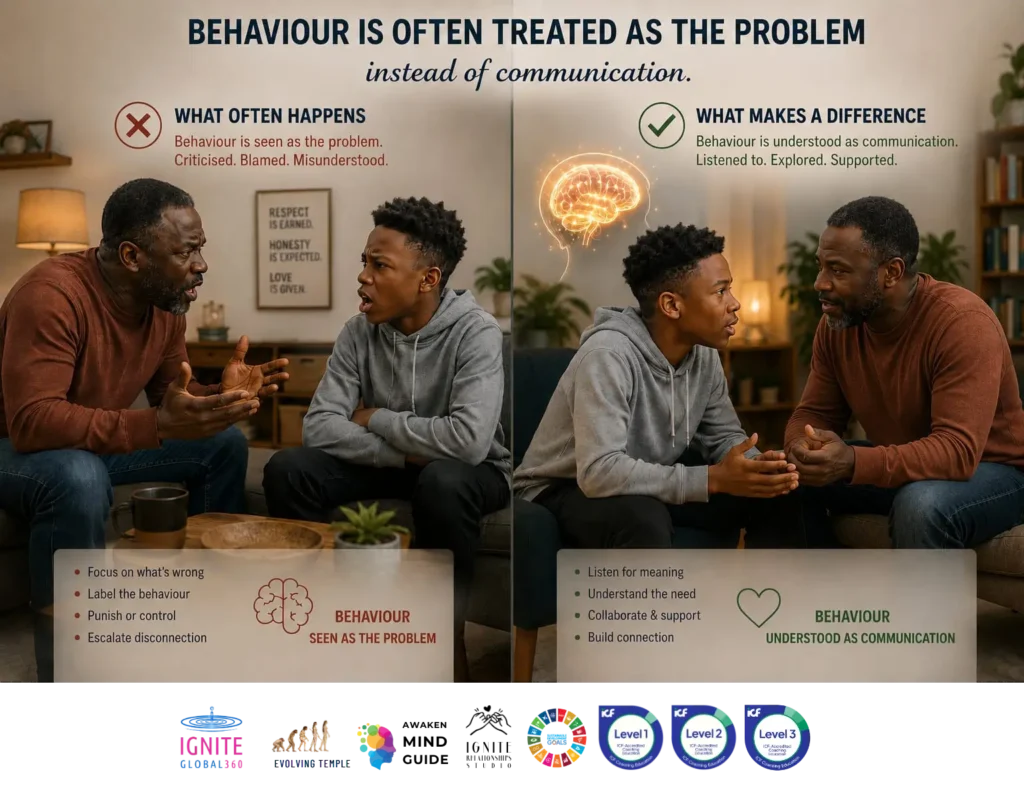
This is often because behaviour itself is being treated as the primary problem rather than as information.

Behaviour is not simply something to correct. In many cases, behaviour is communication.

Children communicate through behaviour long before they can fully communicate through insight, language, reflection, or emotional self-awareness.

What professionals frequently observe externally, aggression, withdrawal, perfectionism, emotional outbursts, avoidance, defiance, clinginess, or emotional shutdown, may actually reflect internal experiences such as:

  • Emotional dysregulation
  • Anxiety
  • Stress activation
  • Unmet attachment needs
  • Shame
  • Sensory overwhelm
  • Relational insecurity
  • Lack of emotional safety

This is why purely behaviour-focused approaches often yield temporary compliance rather than sustainable developmental change.

3. The Missing Piece: The Relational System Around the Child

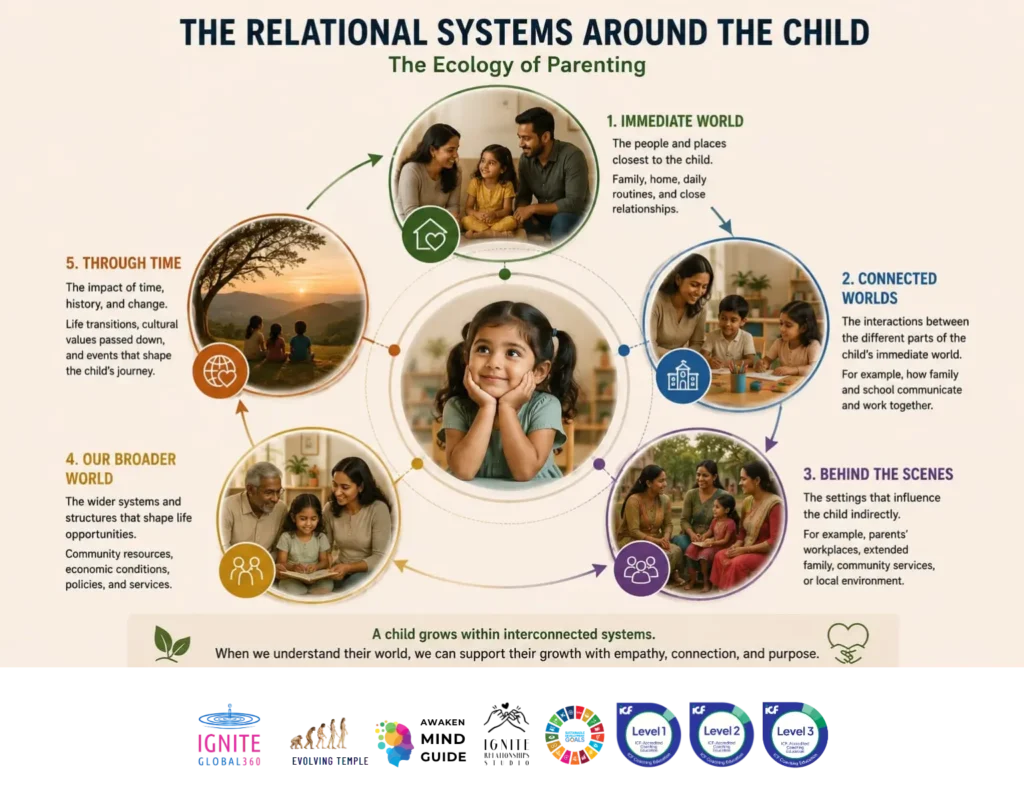
Another major limitation of many adult-based coaching approaches is that they often focus primarily on the individual rather than the relational ecosystem surrounding them.

Children do not develop in isolation.

They develop within relationships, attachment systems, family dynamics, educational environments, and emotional climates that continuously shape their nervous system functioning and sense of safety.

This means that when professionals work with children, they are also indirectly working with:

  • Parental regulation
  • Attachment patterns
  • Relational safety
  • Communication dynamics
  • Intergenerational behavioural patterns
  • Stress within the family system
  • Emotional responsiveness within the environment

Many professionals begin recognizing this intuitively over time.

For example, you may notice that a child’s emotional dysregulation often mirrors that occurring in the home. You may observe that parental anxiety, emotional inconsistency, overwhelm, or unresolved stress strongly influences the child’s behaviour and capacity for regulation.

This is not about blaming parents and caregivers.

In fact, many parents are themselves operating from unresolved developmental experiences that become activated within the parenting relationship. Parenting often unconsciously reactivates attachment wounds, emotional triggers, fears of inadequacy, shame, helplessness, rejection, or loss of control.

Without understanding these deeper relational and developmental dynamics, professionals may continue to address surface-level behavioural symptoms while the underlying system that generates those patterns remains unchanged.

4. The Role of Attachment, Emotional Safety and the Nervous System

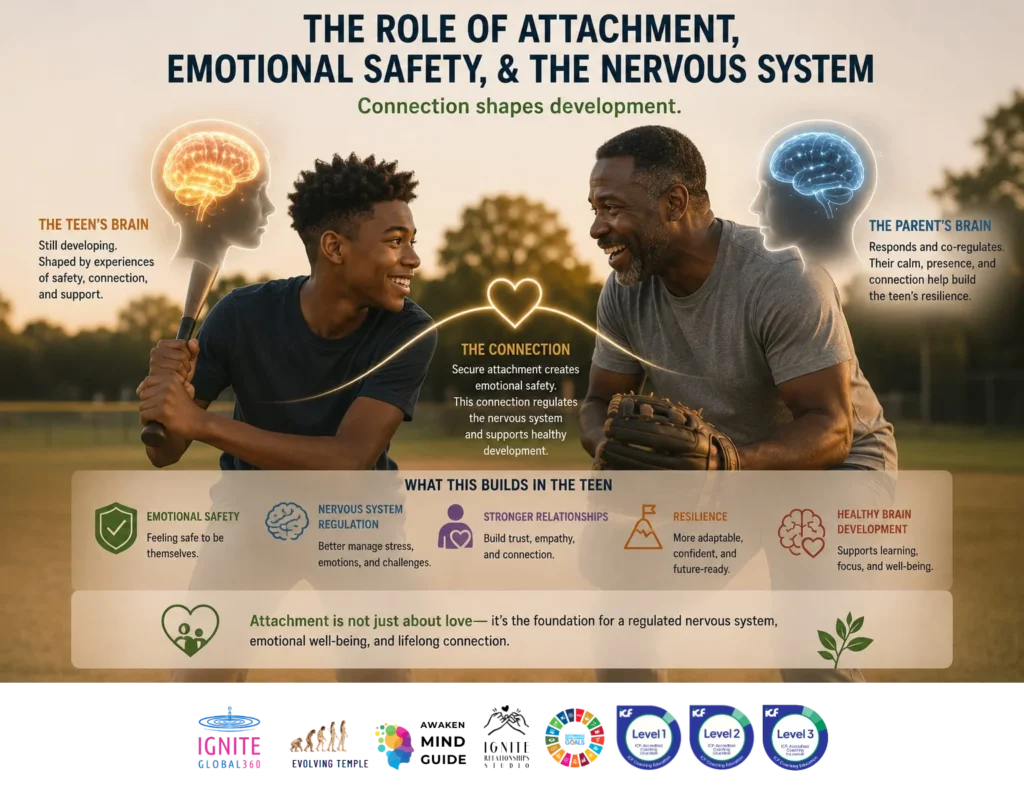
Over the past several decades, developmental psychology, attachment research, interpersonal neurobiology, and trauma research have increasingly demonstrated the central role emotional safety plays in human development.

Children learn, explore, emotionally regulate, and socially engage most effectively when their nervous system experiences sufficient safety.

When safety is compromised, emotionally, relationally, or psychologically, the nervous system shifts toward protection and survival responses.

Importantly, these protective responses do not always appear as obvious distress.

They may appear as:

  • Perfectionism
  • Emotional detachment
  • Hyper-independence
  • Avoidance
  • People pleasing
  • Aggression
  • Control
  • Chronic dysregulation
  • Withdrawal
  • Emotional numbness

Many of the behaviours professionals attempt to “manage” are, in reality, adaptive protective responses developed within the child’s nervous system.

This fundamentally changes how behaviour must be understood.

The question shifts from, “How do we stop this behaviour?”

To,  “What is this behaviour protecting, expressing, or adapting to?”

That shift alone transforms the coaching relationship.

The Future of Coaching Requires a Developmental Lens

The growing limitations many professionals experience are not necessarily evidence that coaching is ineffective. Rather, they reflect the increasing need for coaching models to evolve beyond adult-centric frameworks when working with children, adolescents, and families.

Traditional coaching competencies remain deeply valuable. However, when professionals work with developing human beings, coaching skills alone are no longer sufficient.

Professionals increasingly require understanding in areas such as:

  • Developmental psychology
  • Attachment theory
  • Emotional regulation
  • Nervous system functioning
  • Trauma-informed practice
  • Relational dynamics
  • Family systems
  • Co-regulation
  • Psychosocial development

Because ultimately, children are not simply presenting behaviours to manage.

They are developing human systems adapting to the environments, relationships, and emotional conditions surrounding them.

And the more professionals understand development itself, the more effective, accurate, and sustainable their work with children and families becomes.

Introducing a Specialized Coaching Framework for Child and Adolescent Development and Parenting

This is the very gap that led to the development of the Child, Adolescent Development and Parenting Coach Specialization (CADP): the world’s first and only ICF-accredited specialized coach education framework designed specifically for professionals working with children, adolescents, parents, and family systems.

CADP integrates coaching competencies with developmental psychology, attachment theory, family systems, trauma-informed awareness, nervous system regulation, and parenting science to help professionals move beyond generic coaching approaches into a more developmentally accurate, relationally informed, and systemically aware way of working.

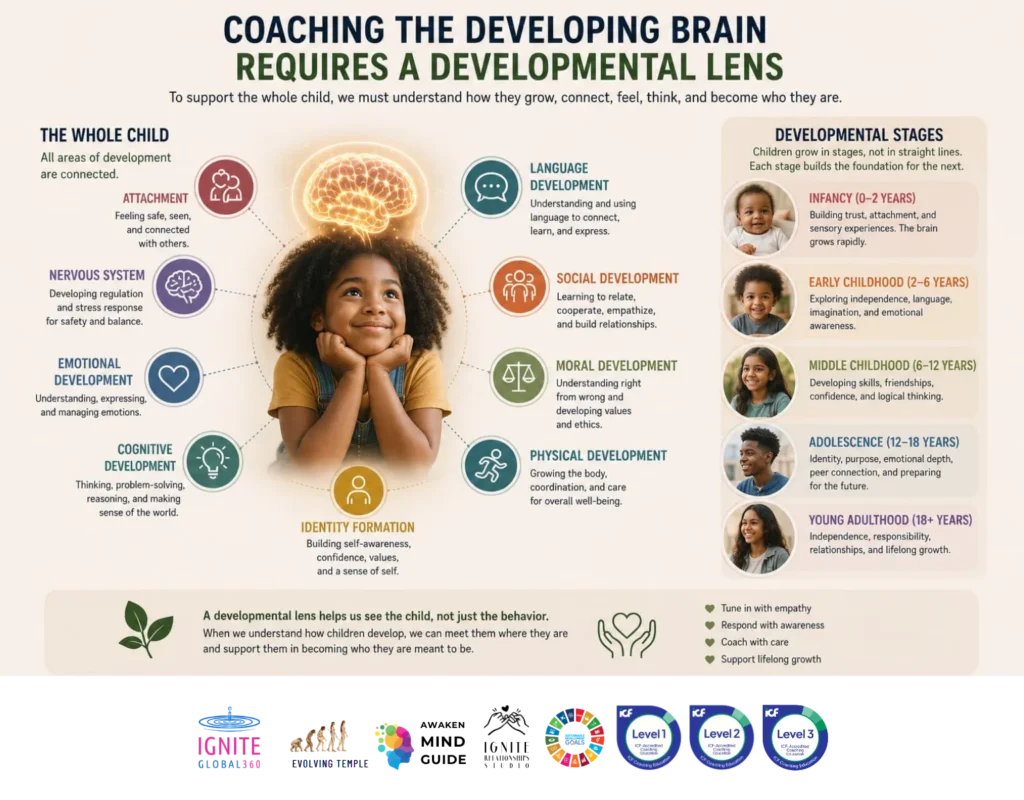
The essential principle at the centre of the CADP framework is that the child’s developing brain must remain at the centre of the coaching process, even when the coach is working only with the parent.

This shifts the focus from simply managing behaviour to understanding the deeper developmental conditions a child requires to regulate, connect, learn, grow, and thrive.

A Systemic and Developmental Approach

CADP was developed through extensive ongoing study, professional observation, applied practice, and continuous refinement of how coaching skills can be ethically and effectively adapted to developmental settings. 

A core feature of the program is its systemic and ecological approach. Through the 360 Panoramic Parenting Vision Model™, professionals are trained to understand the child and the parent within the broader ecosystem surrounding them, rather than treating behaviour as an isolated issue.

This includes exploring the multiple systemic layers shaping development, including parental regulation, attachment patterns, emotional safety, family communication, environmental stressors, school pressures, cultural influences, and relational dynamics.

From this perspective, behaviour becomes information, resistance becomes communication, and parenting struggles become developmental signals rather than personal failures.

More Than a Certification, A Developmental Movement

However, CADP is not simply another coaching certification added to an already crowded industry. It was developed as part of a much larger vision: transforming how future generations are raised, supported, educated, and understood.

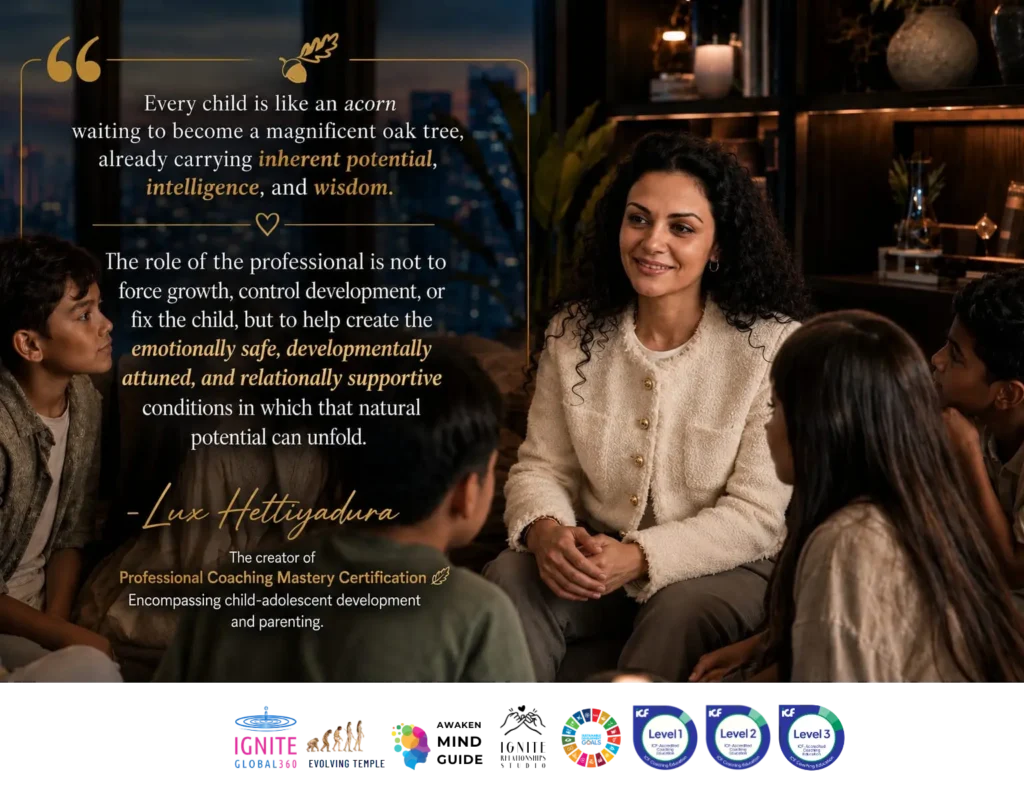
At the heart of the CADP philosophy is the belief that every child is like an acorn waiting to become a magnificent oak tree, already carrying inherent potential, intelligence, and wisdom. The role of the professional is not to force growth, control development, or “fix” the child, but to help create the emotionally safe, developmentally attuned, and relationally supportive conditions in which that natural potential can unfold.

The CADP framework believes that when parents, educators, coaches, caregivers, and helping professionals become developmentally informed, they begin to influence not only individual coaching outcomes but also entire family systems, educational systems, relational patterns, and generational cycles.

This is why becoming a CADP Specialized Coach is not only about gaining a professional credential. It is about becoming part of a developmental movement focused on raising healthier human beings and creating more conscious, emotionally attuned, and developmentally informed environments for generations to come.

That’s why a CADP Coach is not simply a specialized practitioner; they are a developmental catalyst for generational transformation.

Because the future of humanity is shaped by how we raise, understand, nurture, and relate to human beings during their earliest developmental years.

And perhaps there is no better way to conclude this conversation than with the profound words of Mother Teresa,

“What can you do to promote world peace? Go home and love your family.”

With grace and gratitude,
Lux Hettiyadura
Directress, Child/Adolescent Development & Parenting Coach Education – Ignite Global

Continuing the Exploration

If you would like to explore this topic further, watch the recent event held for ICW: Watch here   ,  Watch here

Explore More Resources…

🌱 CADP Masterclass- Join our Complimentary Masterclass on the topic: From Disconnection to Connection, Understanding Rupture and Repair in Parenting and Child Development: Join now

🎥 Keep Learning on YouTube- Tantrums That Seem to Come Out of Nowhere | CADP in a Nutshell : Watch here

📚 Read More- Tantrums That Seem to Come Out of Nowhere: What’s Really Happening in Your Child’s Brain: Read here

EXplore CADP Specialization : CADP Level 1   ,  CADP Level 2

References

John Bowlby (1969) Attachment and Loss: Volume I: Attachment. New York: Basic Books.

Mary Ainsworth, Blehar, M., Waters, E. and Wall, S. (1978) Patterns of Attachment: A Psychological Study of the Strange Situation. Hillsdale, NJ: Erlbaum.

Daniel J. Siegel (2012) The Developing Mind: How Relationships and the Brain Interact to Shape Who We Are. 2nd edn. New York: Guilford Press.

Daniel J. Siegel and Bryson, T.P. (2011) The Whole-Brain Child. New York: Delacorte Press.

Bruce D. Perry and Szalavitz, M. (2017) The Boy Who Was Raised as a Dog. 3rd edn. New York: Basic Books.

Stephen Porges (2011) The Polyvagal Theory: Neurophysiological Foundations of Emotions, Attachment, Communication, and Self-Regulation. New York: W.W. Norton & Company.

Allan N. Schore (2019) Right Brain Psychotherapy. New York: W.W. Norton & Company.

Urie Bronfenbrenner (1979) The Ecology of Human Development. Cambridge, MA: Harvard University Press.

Bessel van der Kolk (2014) The Body Keeps the Score: Brain, Mind, and Body in the Healing of Trauma. New York: Viking.

Gabor Maté and Maté, D. (2022) The Myth of Normal: Trauma, Illness, and Healing in a Toxic Culture. London: Vermilion.

Erik Erikson (1963) Childhood and Society. 2nd edn. New York: W.W. Norton & Company.

Jean Piaget (1952) The Origins of Intelligence in Children. New York: International Universities Press.

Lev Vygotsky (1978) Mind in Society: The Development of Higher Psychological Processes. Cambridge, MA: Harvard University Press.

John Gottman and DeClaire, J. (1998) Raising an Emotionally Intelligent Child. New York: Simon & Schuster.

Dan Hughes (2017) Attachment-Focused Family Therapy Workbook. New York: W.W. Norton & Company.

Peter A. Levine (2010) In an Unspoken Voice: How the Body Releases Trauma and Restores Goodness. Berkeley, CA: North Atlantic Books.

Mother Teresa (n.d.) Quote: “If you want to change the world, go home and love your family.” Available at: Mother Teresa Center (Accessed: 25 May 2026).

 

Join Our Newsletter

Subscribe
Notify of
guest

0 Comments
Oldest
Newest Most Voted

Discover more insights and stories on our blog.

Scroll to Top

Option 2: All-inclusive Program Completion with Practicum and Case Studies

→ Practicum and Case Studies Conducted through an immersive 5-day 7-night Psychedelic Retreat in the Netherlands
(includes 2 nights of complimentary accommodation)
→ Four Individual Preparation Sessions with Fernando (90 minutes each)
→ Three Group Preparation Sessions (120 minutes each)
→ Two Individual Psilocybin Ceremonies during the Retreat
→ Two Group Psilocybin Ceremony during the Retreat
→ Breakfast, Lunch & Dinner – Gourmet Meals
→ Sacred Plant Medicine and Other Therapeutic Necessities Included
→ Four Individual Integration Sessions with Fernando (90 minutes each)
→ Three Group Integration Sessions (120 minutes each)
→ Premium grade private accommodation (private villa in nature setting)

0
Would love your thoughts, please comment.x
()
x