

Table of Contents
ToggleUnderstanding how reflective conversations, psychological safety, and developmental neuroscience come together to support healthier thinking, emotional regulation, identity formation, and lifelong resilience.
Every Conversation Matters More Than We Think
Imagine two teenagers who make exactly the same mistake.
One is met with criticism.
“What were you thinking? You’ll never learn.”
The other is met with curiosity.
“Walk me through what happened. What do you think led to that decision? What might you do differently next time?”
From the outside, the situations appear almost identical. Both adolescents made the same choice, faced the same consequences, and spoke to an adult who cared about them.
Yet beneath the surface, something profoundly different is happening.
The first conversation is more likely to trigger defensiveness, shame, or withdrawal. The second invites reflection, perspective-taking, emotional awareness, and problem-solving.
The difference is not simply in the words that were spoken. It is in the experience created for the developing brain.
Every meaningful interaction with a young person becomes part of the environment in which their brain is learning, adapting, and organizing itself. While no single conversation determines a young person’s future, repeated relational experiences influence how adolescents learn to regulate emotions, think through challenges, build confidence, and understand themselves and others.
This is where coaching becomes far more than a communication technique.
It becomes a developmental experience.
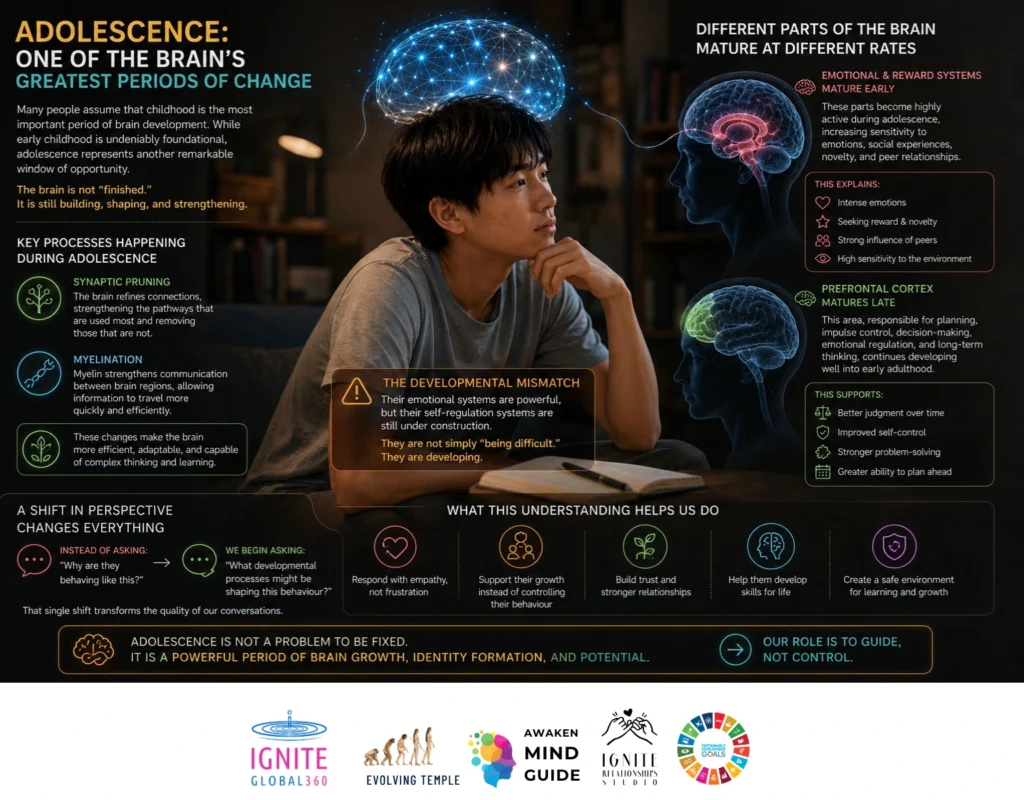
Adolescence: One of the Brain's Greatest Periods of Change
Many people assume that childhood is the most important period of brain development.
While early childhood is undeniably foundational, adolescence represents another remarkable window of opportunity.
During these years, the brain undergoes extensive remodelling. Existing neural connections are refined through synaptic pruning, making frequently used pathways more efficient while less-used connections are reduced. At the same time, myelination strengthens communication between brain regions, allowing information to travel more efficiently.
Importantly, different parts of the brain mature at different rates.
The brain’s emotional and reward systems become highly active during adolescence, increasing sensitivity to emotions, social experiences, novelty, and peer relationships. In contrast, the prefrontal cortex, the region responsible for planning, impulse control, decision-making, emotional regulation, and long-term thinking, continues developing well into early adulthood.
This developmental mismatch helps explain why teenagers often experience intense emotions while still learning how to regulate them.
They are not simply “being difficult.”
They are developing.
Understanding this changes how we respond.
Instead of asking,
“Why are they behaving like this?”
We begin asking,
“What developmental processes might be shaping this behaviour?”
That single shift transforms the quality of our conversations.
Coaching Is More Than Asking Good Questions
Many people think coaching is simply asking powerful questions.
In reality, effective coaching creates conditions that encourage deeper thinking, emotional awareness, personal responsibility, and meaningful learning.
Rather than immediately giving advice, solving problems, or directing behaviour, coaching invites adolescents to become active participants in understanding themselves.
Questions such as:
- What was happening for you in that moment?
- What emotions were present?
- What mattered most to you?
- What options did you notice?
- What have you learned from this experience?
require adolescents to pause, reflect, organize thoughts, evaluate possibilities, and make meaning from their experiences.
These are not merely communication skills.
They are cognitive exercises.
Each reflective conversation provides opportunities to strengthen the very executive functions that continue developing throughout adolescence.
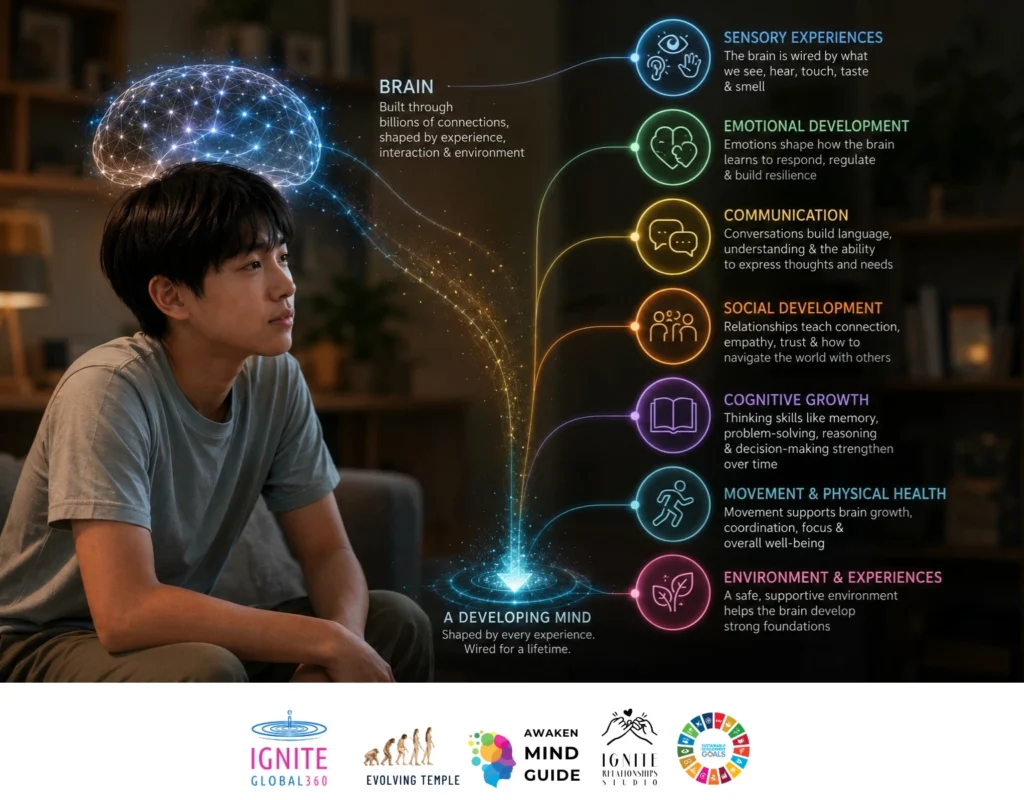
How Coaching Supports the Developing Brain
1. Coaching Strengthens Executive Function
Executive functions are the brain’s management system.
They allow us to:
- Regulate emotions
- Inhibit impulses
- Plan ahead
- Solve problems
- Consider consequences
- Shift perspective
- Make thoughtful decisions
These abilities rely heavily on the developing prefrontal cortex.
When adults consistently provide solutions, adolescents become passive recipients of advice.
When adults coach, adolescents actively engage these executive processes themselves.
Reflective questioning encourages the brain to think rather than simply receive answers.
Like any skill, these capacities strengthen through repeated use.
2. Coaching Supports Emotional Regulation
Emotional regulation is not developed through lectures.
It develops through relationships.
When adolescents experience curiosity instead of criticism, they are more likely to remain emotionally engaged rather than becoming overwhelmed by shame, fear, or defensiveness.
Feeling emotionally safe allows the brain to remain open to learning.
This does not mean removing accountability.
Instead, accountability becomes far more effective when combined with empathy and reflection.
Rather than asking,
“What’s wrong with you?”
coaching asks,
“Help me understand what happened.”
The goal is not to excuse behaviour.
The goal is to understand it well enough to support healthier future choices.
3. Coaching Encourages Metacognition
One of the most important developmental achievements of adolescence is learning to think about one’s own thinking.
Psychologists refer to this as metacognition.
Instead of simply reacting emotionally, adolescents begin asking themselves:
- Why did I react that way?
- What was I feeling?
- What belief influenced my decision?
- What could I do differently next time?
Coaching naturally cultivates this reflective capacity.
Over time, adolescents begin asking themselves the same questions they once heard from trusted adults.
Eventually, the coach’s voice becomes the young person’s inner voice.
4. Coaching Supports Identity Development
One of adolescence’s central developmental tasks is answering a deceptively simple question:
Who am I?
Identity is not formed through instructions.
It develops through exploration, reflection, relationships, and lived experience.
Coaching creates space for adolescents to explore:
- Personal values
- Strengths
- Aspirations
- Fears
- Beliefs
- Purpose
Instead of defining young people, coaching helps them discover themselves.
This process nurtures greater confidence, authenticity, and psychological flexibility.
5. Coaching Fosters Healthy Autonomy
Adolescents naturally seek greater independence.
Sometimes adults interpret this as rebellion.
Developmentally, it is a healthy part of becoming an adult.
Healthy autonomy is not the absence of guidance.
It is the gradual development of independent thinking supported by caring relationships.
Coaching honours this developmental need by inviting adolescents into the decision-making process rather than making every decision for them.
Young people are more likely to commit to choices they have actively participated in creating.
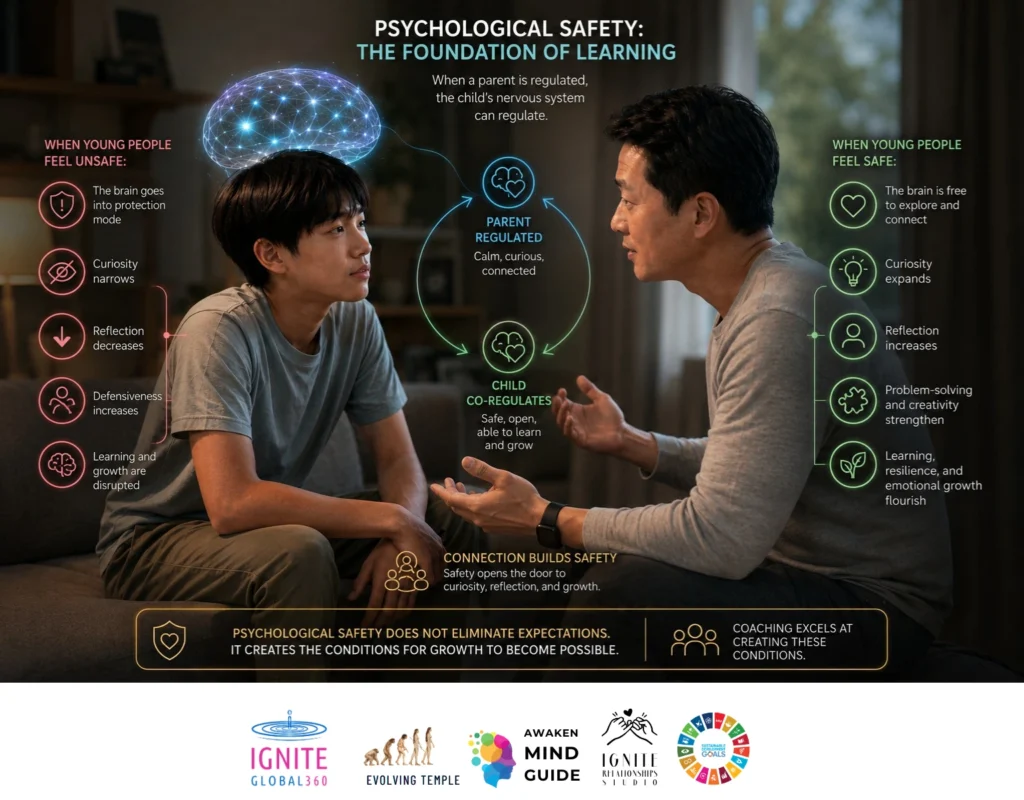
Psychological Safety: The Foundation of Learning
Learning is deeply influenced by how safe we feel.
When adolescents perceive judgment, humiliation, chronic criticism, or emotional threat, the brain naturally prioritizes protection over exploration.
Curiosity narrows.
Reflection decreases.
Defensiveness increases.
Conversely, when young people experience acceptance, respect, empathy, and psychological safety, the brain is better able to engage in learning, problem-solving, creativity, and emotional integration.
Psychological safety does not eliminate expectations.
It creates the conditions for growth to become possible.
Coaching excels at creating these conditions.
Coaching Is Not Permissive Parenting
A common misconception is that coaching means allowing adolescents to do whatever they want.
Nothing could be further from the truth.
Effective coaching combines compassion with accountability.
It maintains clear expectations while respecting the adolescent’s growing capacity for independent thinking.
Boundaries remain.
Consequences remain.
Responsibility remains.
What changes is the conversation.
Instead of controlling through fear, coaching develops responsibility through reflection.
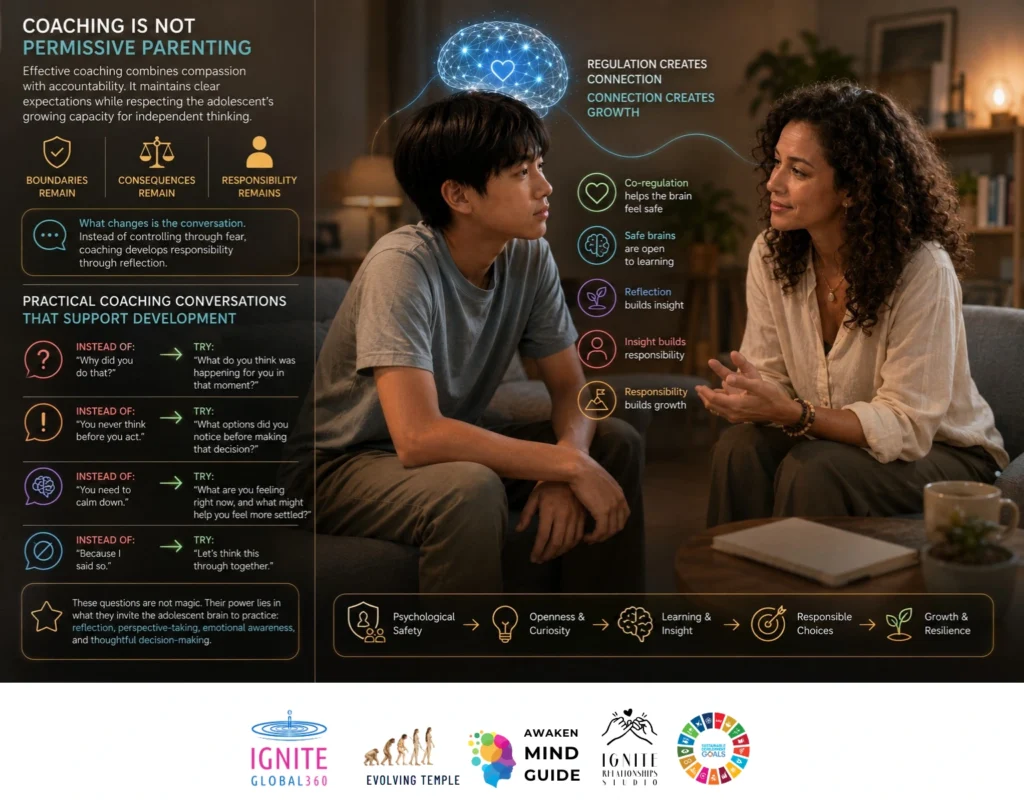
Practical Coaching Conversations That Support Development
Small shifts in language can profoundly change the quality of conversations.
Instead of:
“Why did you do that?”
Try:
“What do you think was happening for you in that moment?”
Instead of:
“You never think before you act.”
Try:
“What options did you notice before making that decision?”
Instead of:
“You need to calm down.”
Try:
“What are you feeling right now, and what might help you feel more settled?”
Instead of:
“Because I said so.”
Try:
“Let’s think this through together.”
These questions are not magic.
Their power lies in what they invite the adolescent brain to practice: reflection, perspective-taking, emotional awareness, and thoughtful decision-making.
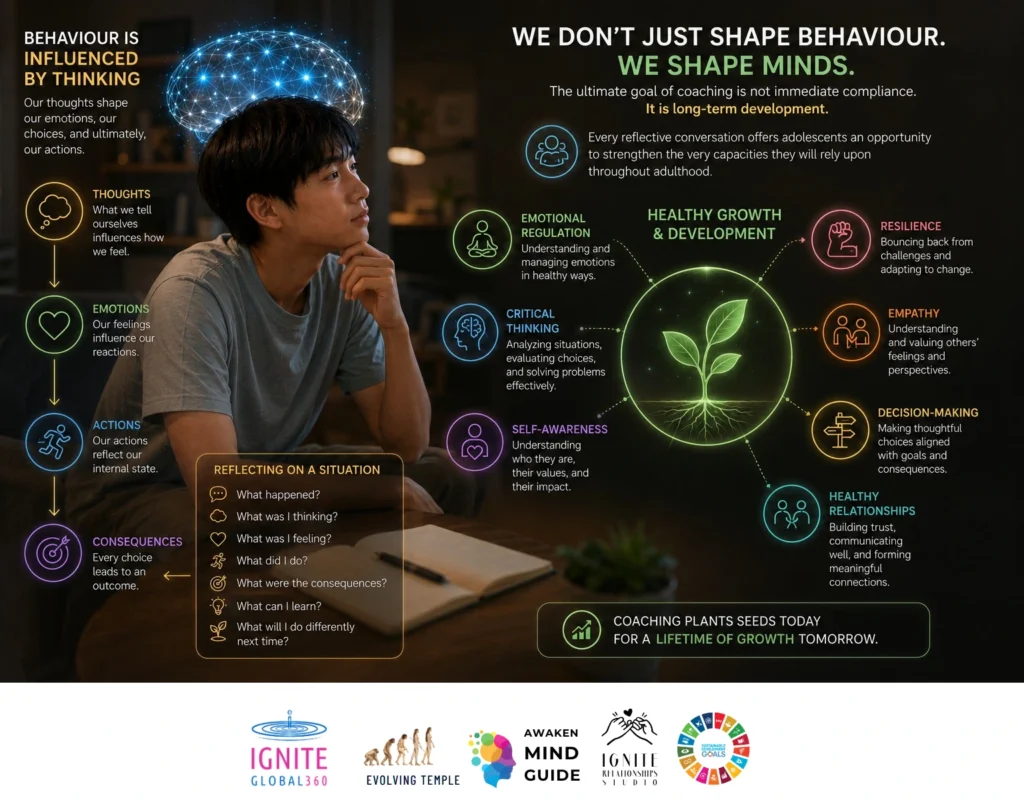
We Don't Just Shape Behaviour. We Shape Minds.
The ultimate goal of coaching is not immediate compliance.
It is long-term development.
Every reflective conversation offers adolescents an opportunity to strengthen the very capacities they will rely upon throughout adulthood:
- Emotional regulation
- Resilience
- Critical thinking
- Empathy
- Self-awareness
- Decision-making
- Healthy relationships
Coaching is therefore not simply about improving today’s behaviour.
It is about helping develop tomorrow’s adult.
Final Reflection
Adolescence is one of the most extraordinary periods of human development.
During these years, the brain is continually adapting to experience, relationships, and reflection.
As parents, educators, coaches, and mental health professionals, we cannot build an adolescent’s brain for them.
But we can help shape the experiences through which healthy development unfolds.
Every thoughtful question.
Every moment of genuine curiosity.
Every conversation grounded in psychological safety.
Every opportunity for reflection instead of reaction.
These moments may seem small, but repeated over time, they become part of the relational environment that supports lifelong learning, emotional resilience, and healthy development.
Perhaps this is the greatest promise of coaching.
Not that it changes young people overnight.
But that, through consistent, intentional conversations, it helps create the experiences from which wiser thinking, stronger emotional regulation, a more secure sense of self, and healthier relationships can grow.
Because sometimes the most powerful thing we can offer a developing brain is not another answer.
It is a better question.
Thank you for reading and for your heartfelt support and interest. As always, your thoughts, insights, and stories are warmly welcome.
If this article has sparked your curiosity, and you’re ready to deepen your coaching skills and understanding of child and adolescent development, I invite you to explore our professional development pathways.
With grace and gratitude,
Lux Hettiyadura
Directress, Child/Adolescent Development & Parenting Coach Education – Ignite Global
Continuing the Exploration
🌱 CADP Masterclass – Join our Complimentary Monthly Masterclasses exploring this specific niche: Join here.
🎥 Keep Learning on YouTube – Tantrums That Seem to Come Out of Nowhere | CADP in a Nutshell: Watch here.
📚 Read More
The Neuroscience of Learning: How Early Relationships Shape Brain Architecture and Academic Outcomes: Read here.
🌱 Attachment Healing Community
A free monthly space to gently heal your attachment system through safe, nurturing connection. Join here.
🤝 Share the Love
If this article touched you, share it with someone who may need these words today. Sometimes, the smallest act of passing on knowledge creates the biggest ripple in someone’s healing journey.
References
Siegel, Daniel J. (2020) The Developing Mind: How Relationships and the Brain Interact to Shape Who We Are. 3rd edn. New York: Guilford Press.
Siegel, Daniel J. (2014) Brainstorm: The Power and Purpose of the Teenage Brain. New York: Penguin Random House.
Shonkoff, Jack P. and Phillips, Deborah A. (eds.) (2000) From Neurons to Neighborhoods: The Science of Early Childhood Development. Washington, DC: National Academies Press.
National Scientific Council on the Developing Child (2004–2020) Working Papers. Cambridge, MA: Harvard University.
Center on the Developing Child (2023) Brain Architecture. Cambridge, MA: Harvard University.
Blakemore, Sarah-Jayne (2018) Inventing Ourselves: The Secret Life of the Teenage Brain. London: Doubleday.
Blakemore, Sarah-Jayne and Mills, Kathryn L. (2014) ‘Is adolescence a sensitive period for sociocultural processing?’, Annual Review of Psychology, 65, pp. 187–207.
Casey, B. J., Jones, Rebecca M. and Hare, Todd A. (2008) ‘The adolescent brain’, Annals of the New York Academy of Sciences, 1124(1), pp. 111–126.
Steinberg, Laurence (2014) Age of Opportunity: Lessons from the New Science of Adolescence. Boston: Houghton Mifflin Harcourt.
Steinberg, Laurence (2005) ‘Cognitive and affective development in adolescence’, Trends in Cognitive Sciences, 9(2), pp. 69–74.
Kolb, Bryan and Gibb, Robbin (2011) ‘Brain plasticity and behaviour in the developing brain’, Journal of the Canadian Academy of Child and Adolescent Psychiatry, 20(4), pp. 265–276.
Deci, Edward L. and Ryan, Richard M. (2000) ‘The “What” and “Why” of Goal Pursuits: Human Needs and the Self-Determination of Behaviour’, Psychological Inquiry, 11(4), pp. 227–268.
Ryan, Richard M. and Deci, Edward L. (2017) Self-Determination Theory: Basic Psychological Needs in Motivation, Development, and Wellness. New York: Guilford Press.
Bandura, Albert (1997) Self-Efficacy: The Exercise of Control. New York: W.H. Freeman.
Vygotsky, Lev S. (1978) Mind in Society: The Development of Higher Psychological Processes. Cambridge, MA: Harvard University Press.
Rogers, Carl R. (1961) On Becoming a Person. Boston: Houghton Mifflin.
Whitmore, John (2017) Coaching for Performance. 5th edn. London: Nicholas Brealey.
International Coaching Federation (2021) ICF Core Competencies. Lexington, KY: International Coaching Federation.